
The shop is closed just now. The shop is not open for orders yet. Everything here is real and grown in my own yard — have a look around — but I am not taking money until the last few things are in place. Ask about a plant

NZ pach tillford seal. short spines recorded.

Pachanoi

NZ pach tillford

Partially documented

Also written as Tilford, Tillford

Tilford is honest about what it is: a plain New Zealand that had no name until the grower who was breeding with it needed one, at which point the street where the friend who gave it away lived supplied the label. It shows the standard species picture — green , short spines, shallow notches above the — and no trait specific to this has been recorded. Its value is as a tracked breeding line rather than as a distinctive-looking plant.Too little stands behind this for us to confirm it.

  • short spines
  • notched areoles
  • green skin

PachanoiNamed clone: One original plant and every cutting taken from it, given a name by a grower.

Of the 11 things this page says, 1 is something several independent sources agree on, 1 names who reports it and 9 are marked as something we cannot confirm. Where a line is not settled, it says so underneath.

Added 23 Aug 2026

At a glance

Species

Trichocereus pachanoi

syn. Echinopsis pachanoi

Filed under Pachanoi

Parents

Not recorded

No source names a mother or a father for this one.

Origin

Māris Dainis, after the street where the friend who gave them the plant lived

no source says whether it is seed-grown or a cutting line

In the yard

Family line

what the record holds

No source in this library records a cross for NZ pach tillford. Nobody names a mother or a father for it, and no other entry here names it as a parent.

That is the record, not an oversight: of the 749 names in this library, 693 have no recorded relation either. Most named clones were selected, cut and passed along without anyone writing down what they came out of. A parent goes in here when a source states it and never because a name looks like one — a wrong pedigree would travel further than a blank one, because pedigrees get copied.

If you know where it came from, tell us — a person reads everything before it appears.

The longer version

Species, as our sources record it: pachanoi from New Zealand.

It began as an unnamed, ordinary New Zealand pachanoi that a friend gave to Dainis.Too little stands behind this for us to confirm it.

When Dainis started breeding with the plant it needed a label, so it was named after the street where that friend lived, purely to keep the straight.Reported, but not confirmed.

Asked whether the plant had any link to New Plymouth in New Zealand, Dainis knew of none.Too little stands behind this for us to confirm it.

Where the name comes from

Māris Dainis introduced the clone to the wider community.Too little stands behind this for us to confirm it.

Character

A bar is drawn only where one of the lines below states it — never from the species, never from a photograph.

  • Not documented yet.

  • nearly smooth to heavily spined: this one leans towards nearly smooth, read from the spines line below.
  • Not documented yet.

Skin
skin and ribs: the ordinary New Zealand pachanoi picture — green skin and ribs with shallow notches above the areoles.Too little stands behind this for us to confirm it.
Spines
Short and inconspicuous.One source states this, and our house botanist has checked it. Short, inconspicuous spines are an ordinary condition for these plants.
Growth habit
No cultivation quirks have been reported for it, and no variation unique to this clone has been written down.Too little stands behind this for us to confirm it.

What the sources say

The wiki page carries a banner saying it was assembled by a bot from community chat and has not been checked by an editor. The spelling is unstable even within one page: the title reads tillford and the text reads Tilford.Too little stands behind this for us to confirm it.

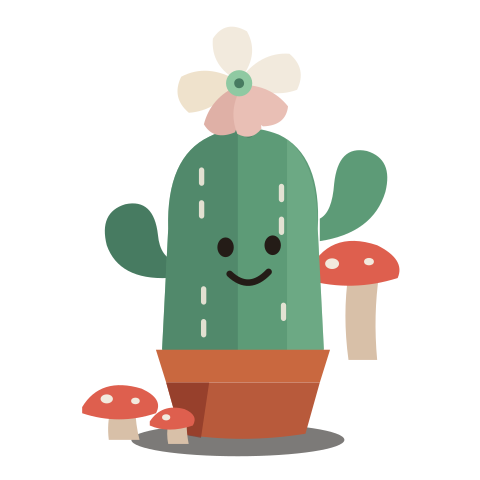
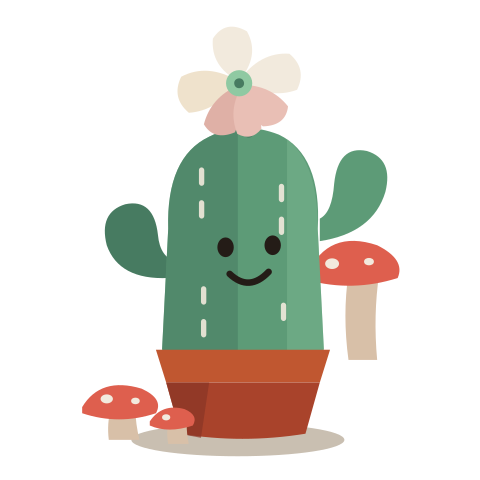
Drawing of a pachanoi-type column: broad, with low rounded ribs, almost no spines, and a small notch in the rib above each areole.
A Pachanoi column, drawn. We don't grow this one, and we will not borrow anybody else's photograph of it.

Filed under the same family, Pachanoi. The better-documented ones come first.

Keep exploring

Cultivar histories in this hobby are passed between growers; where sources disagree we say so rather than pick a side.