
The cultivar library
Every name, one wall
A cultivar name is a claim: that this plant was cut from one particular original, and that yours will grow up looking like that one. Here are 749 names we found a real source for, each with a mark of its own. The ring is the plant itself — its ribs, its spines, its shape — drawn from what growers have recorded, and its colour is the species family. The name is always written out in full underneath. 55 of them grow in this yard; the rest are here because you will meet them while you shop.
How to read the wall
Every plant draws its own mark
- nothing recorded yet
- 7 ribs, short spines
- monstrose
- crested
The ring is the plant seen from above, and nothing is added to it that a source did not state. 648 of the rings in this library are bare, which is the honest answer rather than a gap in the drawing. The name under each one is always written out in full.
Where a ring is bare and the tile is grey, nobody wrote that plant’s story down where we could find it. If you know one of them, tell us — a person reads everything before it appears.
How a seal is made →How well documented
- Well documented82 names
- More than one source describes this cultivar, or one source describes it in detail.
- Partially documented238 names
- Our sources record something real about this name — often only how often it comes up for sale — but not its full story.
- Name only429 names
- We have only ever seen the name. No history, no traits, nothing we can stand behind.
The tag is about our sources, not about the plant. Colour is the species family, spelled out beside every chip and under every seal; a grey, dashed plate means we could not place the plant at all.
Seven families, seven silhouettes
The drawings are the real differences: rounded ribs and a notched brow on a pachanoi, deep notches and frosted blue skin on a peruvianus, long needles on a slim bridgesii, a smooth near-spineless scopulicola, one flank from each parent on a cross. The dashed outline means we could not put the plant in any of these families — either nobody named a species for it, or the sources place it outside Trichocereus altogether.
145–180 of 492 names · page 5 of 14 · best documented first · A–Z instead
Ahulx
Other Trichocereus2023–2026 · mostly grafts
Albi
name only
Alchemist
Other Trichocereus2021–2026 · mostly tip cuttings
Alko
name only
Andre The Giant
name only
Anita
Other Trichocereus2021–2026
Anna
name only
Annie
Other Trichocereus2022–2026 · often variegated
Anok
name only
Anra
Other Trichocereus2022–2026
Aoxomoxoa
Other Trichocereus2022–2026 · mostly grafts
Apricot
Other Trichocereus2024–2026
Apu Pichu
Other Trichocereus2022–2026
Aqualung
Other Trichocereus2021–2025
Arequipa
Other Trichocereus2022–2026 · mostly grafts
Azul
Other Trichocereus2023–2026 · mostly tip cuttings
Bach
Other Trichocereus2021–2026
Badassii
name only
Barbara's Juuls
Other Trichocereus2022–2025
Barbie
Other Trichocereus2022–2026
Base
name only
Battleship
Other Trichocereus2022–2026 · mostly grafts
BBG 481540
name only
Bendigo
name only
Bert
name only
Betsy
Other Trichocereus2022–2026
Betty Boom
Other Trichocereus2022–2026
Big Bertha
name only
Bigfoot
Other Trichocereus2021–2026 · mostly mid cuttings
Bigrock
Other Trichocereus2022–2025 · mostly tip cuttings, mid cuttings
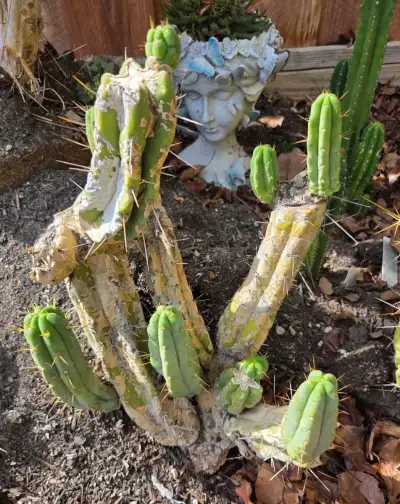
- Grown at Mysterious Yard
Birdland
name only
BK09511.7
Other Trichocereus2022–2026
BK10508.1
Other Trichocereus2022–2026
BK14518.5
Other Trichocereus2022–2026 · mostly tip cuttings
BKV
Other Trichocereus2024–2026
Blosser
Other Trichocereus2022–2026
Sources
How this hub was written
Nothing here is copied. Every page was written from a fact list I built by reading, watching and cross-checking the sources below, with each fact tagged to where it came from. I keep that fact-by-fact record on my side of the counter; what you read here is what held up after checking it against my own plants.
The community wiki, written by many growers and published under a Creative Commons BY-NC 4.0 licence. We use its facts and reproduce none of its text or pictures.
@sanpedromastery6262 on YouTube
A hobby grower filming the same collection through two very different climates, which is where a lot of our seasonal numbers come from.
A one-person nursery in San Diego County filming its own practice in the open, in a climate close to this one.
Where growers argue things out in public. Useful for what actually goes wrong, and for seeing where opinion is split.
A Southern California nursery whose buyer guides and posted policies are the clearest record I found of what a cutting in the post should be like. They are also a competitor, and I read them as one.
And checked against
Growers know things nobody has written down, and those five are where that knowledge lives. But anything that can be checked against somebody who publishes under their own name and answers for it has been.
University of Arizona Cooperative Extension
A land-grant university's extension service, on sunburn and acclimation, freeze damage, planting depth, drainage, over-watering, rot and pests. Where this site and a forum disagree about water, this is the tiebreaker.
The Royal Horticultural Society
A national horticultural society's own growing guide: the watering year, the cool dry winter rest, mixes, pot size and how long a cut takes to callus.
A botanical garden's pest advice, written for cacti and succulents specifically — what mealybugs, scale, spider mites and root mealybugs look like, and what actually shifts them.
The International Plant Names Index
Kept jointly by Kew, the Harvard University Herbaria and the Australian National Herbarium. It is where the species names on this site were checked against the record of what has actually been published, and by whom.
Haseltonia, the yearbook of the Cactus and Succulent Society of America
Peer-reviewed taxonomy. The argument about macrogonus, pachanoi and peruvianus is settled in papers like this one, not in a comment thread, and this is the paper that made the change.
Nine more sit behind these pages the same way — extension horticulture from Illinois, South Carolina and two California counties, the Caryophyllales Network, the Desert Botanical Garden, a society’s grafting article and a journal paper on the family tree. Every one of them, and how much of this site rests on each, is on the sources page.
Every photograph on this site is of a plant grown in this yard — nobody else’s. The teaching pictures are drawings rather than photographs: a drawing can label the one thing it is teaching, hold two plants in the same light, and leave out everything that would only distract. And I will not tell you what your cactus is from a photograph: light, age and water change every feature people identify these plants by, so a photo is a hint and never a verdict.
Written from scratch off a cited fact list, never copied. Learned from the sanpedrocact.us community wiki (CC BY-NC 4.0), @sanpedromastery6262 and @IMDAVESBUD on YouTube, r/sanpedrocactus and medicactus.com's buyer guides, then checked against university extension horticulture, botanical gardens, cactus and succulent societies and the published botanical record. I will not name a plant from a photograph.
Every source behind this site →